
Rafting the Colorado River Through Cataract Canyon
Wildness, Management, and a Week of Healing
The Colorado River in Canyonlands National Park feels wild — especially as it drops into Cataract Canyon, one of the most powerful whitewater sections in the Colorado River Basin.
It is not untouched.
By the time it reaches the Potash boat ramp outside Moab, its flow has already been shaped by snowpack forecasts, upstream reservoirs, and agreements written nearly a century ago under the Colorado River Compact. Water that once moved entirely according to gravity now moves within allocations.
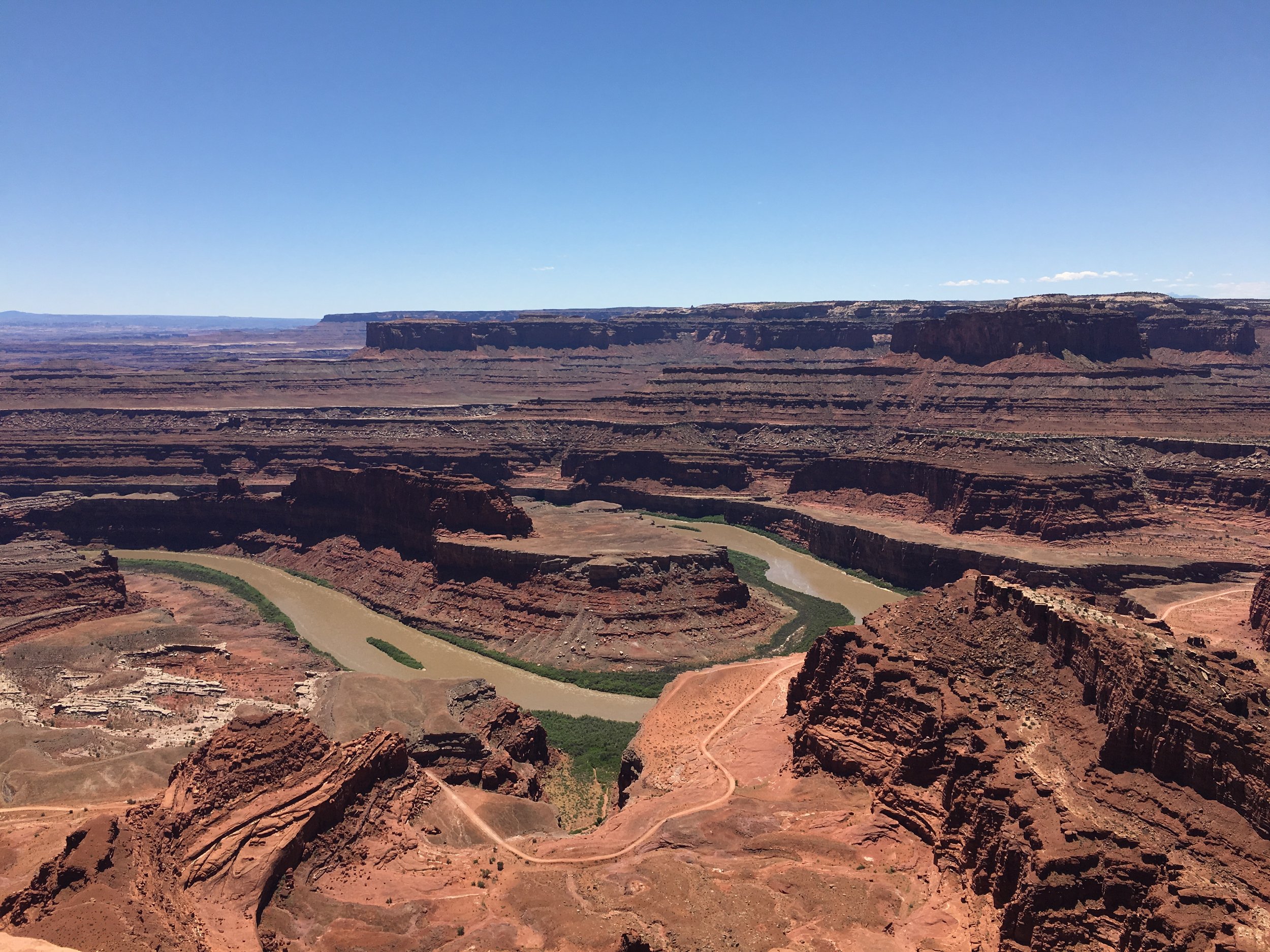
Colorado River carving through layered sandstone near Canyonlands National Park, Utah. Millions of years of uplift and erosion exposed in a single bend of the river.
But when you drift into the current below the confluence of the Green and Colorado Rivers, policy feels distant.
The canyon walls rise. The river narrows. The current begins to speak in force instead of numbers.
Our group gathered for a 100-mile descent through Cataract Canyon — veterans from different branches of service, different deployments, and different injuries. The trip was designed for healing. No speeches. No diagnoses. Just movement through a landscape large enough to quiet what we carried.
Inside the canyon, hierarchy dissolved quickly. The river does not recognize rank.
It recognizes weight. Momentum. Attention.
The first days were deceptive. Flatwater moved steadily beneath walls stained with desert varnish. Sandstone layers revealed deep time — Permian seas, uplift, erosion measured in hundreds of millions of years. The Colorado did not create the plateau. It cut into it. Patiently. Relentlessly.
Along stretches of canyon wall, petroglyph panels marked human presence long before dams, compacts, or boundary lines. Figures chipped into stone recorded movement, animals, memory. They were not statements of control. They were acknowledgments of existence.
Not all marks in canyon country are ancient—and not all of them are mine to interpret. In the talus and sun-baked rubble, I found a boulder carrying a pale, hand-cut message: “July 22, 1891” and the name “C.M. Wright,” alongside an abbreviated company tag (“M.S. Imp Co”) likely referring to a mining or survey venture operating along the Colorado River corridor in the late nineteenth century.
While many people think first of John Wesley Powell’s expeditions down the Colorado River in 1869 and 1871–72, this inscription belongs to a later era of river travel. By the 1890s, the Colorado was drawing survey crews, mining interests, and small commercial ventures attempting to navigate, map, or exploit its corridor. The river was no longer unknown—it was being measured, claimed, and tested.
Standing over that stone, the canyon felt like a ledger. The river keeps the true record—sand, silt, floodlines, and time—while we leave names behind, hoping the rock will remember us.
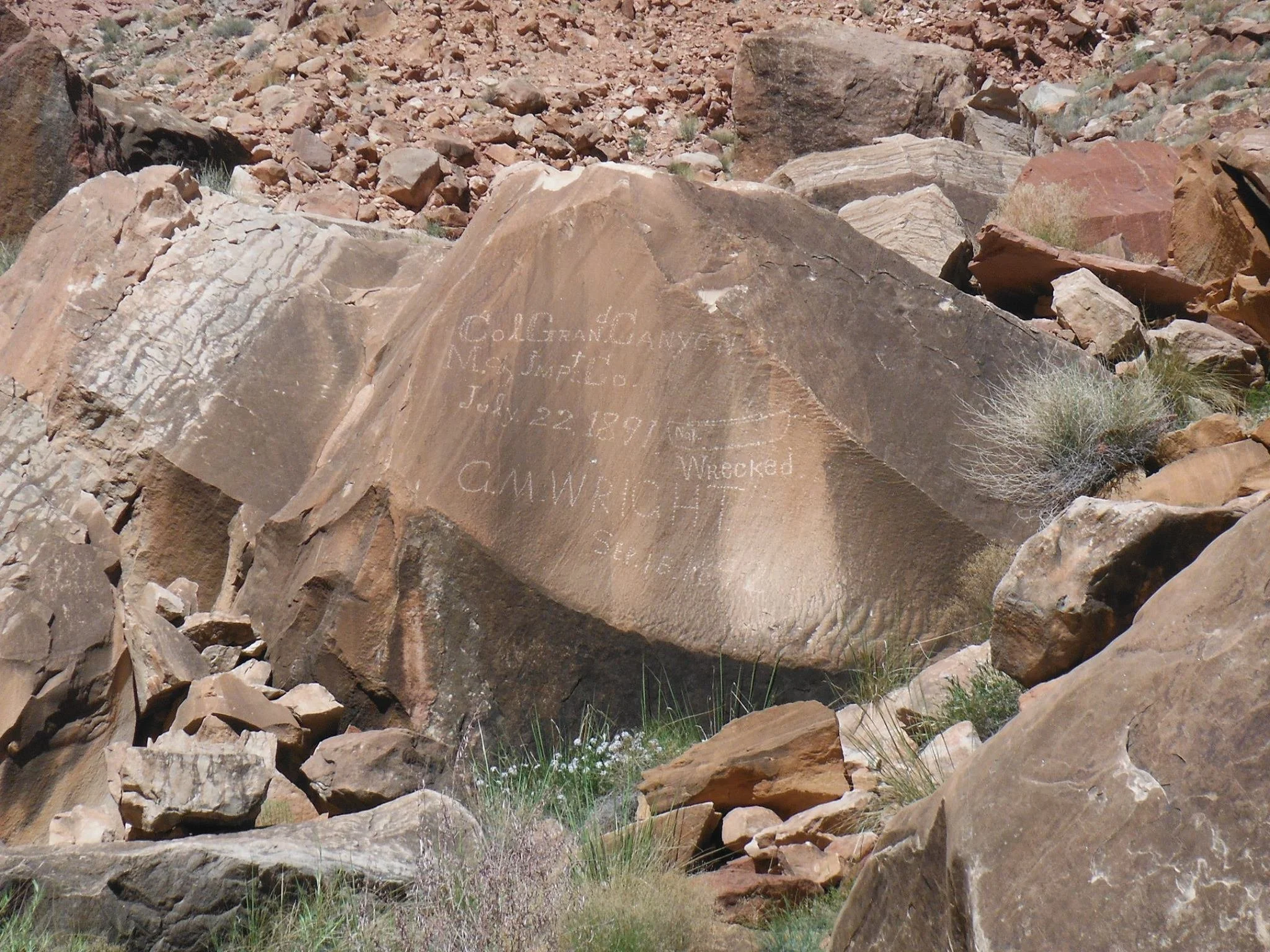
Inscription dated July 22, 1891, along the Colorado River corridor in Cataract Canyon. A mark from the era of survey crews and mining ventures that followed John Wesley Powell’s expeditions.
Human presence here has always been adaptive.
Modern infrastructure took a different approach.
The Colorado River Basin now supports tens of millions of people. Its water is stored behind dams, diverted across state lines, and measured in acre-feet. Snowpack variability and prolonged drought have reduced flows across the basin in recent decades. Yet inside Cataract Canyon, the river still gathers energy as the gradient steepens.
Cataract is not subtle.
Big Drop One builds slowly on the horizon until the river disappears. Then the raft tips forward into whitewater that folds back on itself. Waves stack high enough to block out the sky. Hydraulics grab at the tubes. Bedrock geometry, sediment load, and discharge volume combine into something kinetic and immediate.
We hit the first wave square.
The second one flipped us.
There is a moment underwater when sound disappears. The current pulls. Cold, sediment-heavy water replaces breath. Training surfaces instinctively — stay oriented, protect your head, find light.
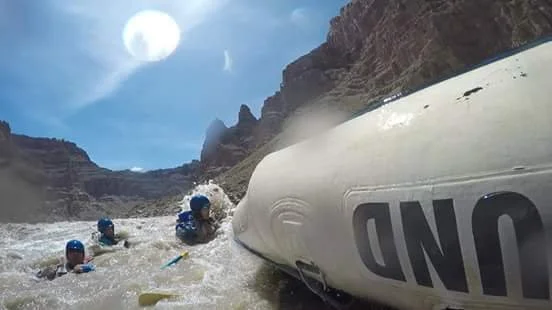
Swimming Big Drop II in Cataract Canyon on the Colorado River. Cold, sediment-heavy water and overturned raft in one of the most powerful whitewater sections in Canyonlands National Park.
Then you break the surface and the canyon roars back into existence.
We swam that rapid. Boats scattered. Guides regrouped downstream. Everyone accounted for. Adrenaline replaced hesitation. No one spoke about injury. We spoke about the line we should have taken.
There is clarity in that kind of force.
In uniform, many of us operated inside systems that felt ambiguous. The river was not ambiguous. It telegraphed consequence. If you read it correctly, you moved through. If you misjudged it, you paid for it.
The canyon did not heal us.
But it leveled us.
Each night, we pulled the rafts onto sandbars and slept without tents. No walls. No artificial light. Just sleeping bags on the riverbank and the sound of current moving past camp. Canyonlands National Park is designated as an International Dark Sky Park, and away from Moab’s glow the night sky feels almost architectural in its density.
Stars sharpen. Planets hold steady. The Milky Way stretches unbroken across the canyon walls.
With no light pollution to dull it, deep space becomes visible again.
Lying there on the sand, the scale shifts. Geologic time below you. Cosmic time above you. A regulated river moving between them.
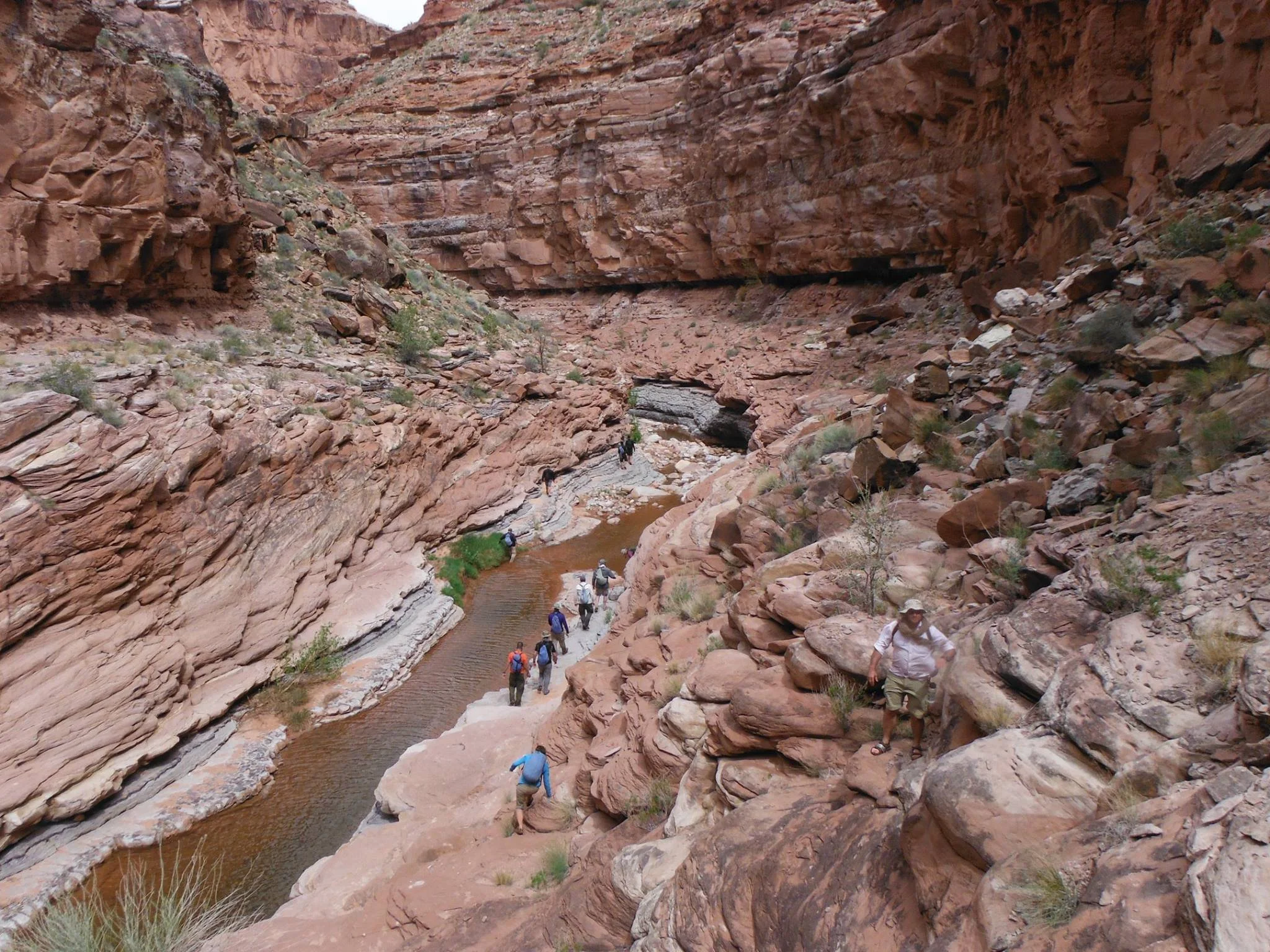
Exploring a side canyon off the Colorado River during our 100-mile descent through Cataract Canyon. Movement through stone, water, and time.
As we moved into the lower canyon, the gradient eased. Historically, this stretch transitioned into the upper reaches of Lake Powell, the reservoir formed behind Glen Canyon Dam in 1963. In high water years, the backwater pushed upstream into Cataract Canyon, muting rapids and burying beaches. In recent drought cycles, receding reservoir levels have allowed parts of the canyon to re-emerge — sediment exposed, side canyons visible again.
The difference between river and reservoir is subtle at first.
Current becomes drift. Confinement becomes storage.
One shaped by gravity and incision. The other by containment and policy.
Abbey wrote of freedom in these canyons. Today, the Colorado River moves through a landscape where freedom and management coexist. Acre-feet are debated. Reservoir elevations are tracked daily. Drought contingency plans define release volumes.
And still, inside Cataract Canyon, the river demands humility.
It flips rafts.
It strips away illusion.
It reminds you that regulation is not the same as control.
For a week, we moved through geology older than memory, through a watershed negotiated in boardrooms, through water that has carried both exploration and extraction. We carried our injuries into the canyon and left with something quieter — not repaired, not erased — but recalibrated against scale.
The canyon remembers gravity.
The basin remembers allocation.
The river remembers neither.
It moves because it must.
And between gravity and policy, between incision and storage, the Colorado continues to cut its way forward.